
Featured

Dents & Dings – Discounted Model Kits & Hobby Items with Box Damage
$12.00 $10.00 ~ $80.00
Bandai Grand Ship Collection #03 Going Merry Model Kit
$22.00 $18.26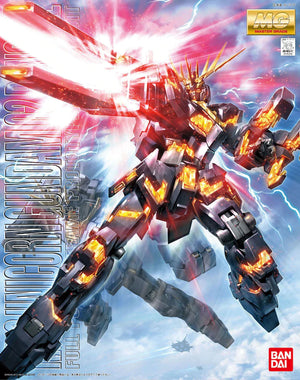
Bandai MG 1/100 RX-0 Unicorn Gundam 02 Banshee Model Kit
$63.00 $53.55
Endless Create SR-01 Shurado Series Byaki MGSD-Style Model Kit
$50.00 $35.00
Bandai HGGQ #04 1/144 gMS-α Red Gundam Model Kit
$30.00 $21.00What's Actually Inside the IN ERA+ Fenrir? An Unboxing Review


Gold claws. Exposed cylinders running down the spine. A tail that doubles as a sword. A detachable fighter jet docked in the chest. The Fenrir looks wild in photos, and the built kit photos circulating online don't exactly tone it down. But photos of a finished build don't tell you what's actually in the box before you start cutting runners.
We opened one up and went through everything inside. Here's what you're actually getting.
A Quick Note on Infinite Nova
Infinite Nova is one of the heavier-hitting names in the Chinese third-party mecha space right now. The label is a collaboration: Infinite Dimension does the design work, SNAA handles engineering and production, and IN ERA+ is the brand on the box. We covered the full breakdown of how those three names connect in this earlier piece if you want the deeper context. The short version: their lineup splits into three series. PMD kits ship with pre-assembled diecast alloy frames, RMD kits give you a fully buildable mechanical skeleton, and UMD kits trade frame complexity for faster builds and lower price points.
The Fenrir is the first 1/72 entry in the RMD line and currently sits at the top of the catalog. The name comes from Norse mythology, and the design leans into that with clawed feet, an articulated tail, and a dual head design (one standard mecha face, one beast-mode face). If you've built a Master Grade you'll recognize the engineering DNA - pre-assembled inner joints, layered armor over a buildable frame, the whole frame-then-skin construction philosophy. The Infinite Nova IN ERA+ Fenrir is available now.
The Box (All Three of Them)

The kraft outer shipping carton with line-art Fenrir printed across the front.
Most third-party kits arrive in whatever shipping box the retailer can find that fits, occasionally with a label slapped on top of the retail packaging. Infinite Nova does it differently. The Fenrir ships inside its own purpose-built kraft carton with a line-art Fenrir printed across the front, and that carton is sturdier than anything we'd put it in. The only other manufacturer we've seen go to this level of shipping protection is Motor Nuclear, and it means the printed retail box arrives in the same condition it left the factory in.
The shipping carton measures 60.3 x 41.3 x 16.2cm - bigger than most Master Grade boxes and closer in footprint to a PG.

The painted retail box. Premium illustration with red accent banding and the F.N.R-09 designation.
Inside the shipping carton, you find the printed retail box - thick cardstock with a carry handle on top, painted illustration on a white field with red accent banding, the F.N.R-09 designation, the IN ERA+ logo in the corner. The print quality and finish here are on par with what you'd expect from a PGU. Below that there's another protective inner sleeve with line art on it. By the time you've worked through three layers of box, you have a pretty clear sense of what Infinite Nova thinks this kit is supposed to be.
Inside, the runners sit in stacked layers separated by thin protective sheets, with the pre-assembled joint units in their own segmented blister tray. 22 bags. 34 panels.
What's Inside the Box

Everything in the Fenrir laid out: 34 runners across 22 bags, the pre-assembled joint box, instruction manual, decal and sticker sheets, display base, and assembly cable.
The Fenrir gives you 34 runners and approximately 960 parts, all ABS plastic. The runner condition is excellent: no warping, no flash anywhere visible, and the pre-painted parts are clean enough that any minor flash would be hidden under the paint anyway.
The runners break down into a few groups. The frame sprues come in two molding colors, a dark charcoal gray and a slightly brownish gray, and they're loaded with sculpted detail - cable textures, cylinder housings, fin patterns, and panel lines on parts that will eventually get covered by armor. The external armor runners are mostly white in two slightly different shades, plus separate runners for red and black accent pieces.


The pre-painted gold (G) and silver (H) runners. These are real paint, not colored plastic.
Then there are the pre-painted metallic runners, which are the highlight of the parts breakdown. The Fenrir uses a gold runner (labeled G) and a silver runner (labeled H) for visible mechanical detail throughout the body - shoulders, claws, joint accents, thrusters, the spine running up the back. This is real paint, applied at the factory, not gold-tinted plastic pretending to be gold. The coverage is even, the gloss is consistent, and there's no blotching across either runner. These parts also use under-gate construction, meaning the gate connection is hidden inside the part rather than on a visible surface, so you don't have many nub marks to clean up after assembly if any.
The translucent (special effects) runners come in clear blue, used for the eyes, the cockpit canopy on the chest fighter, and a few other sensor-style details. There's a silver foil layer that goes behind the clear blue parts, and when light hits them through the plastic it gives them a jewel-like glow that's surprisingly effective in person.

The pre-assembled joint set in its own black box with a blister tray. Hips, shoulders, knees, ankles, and a few smaller pieces - all factory-snapped.
The pre-assembled joints are packed in their own black box with a clear plastic tray. These are the load-bearing alloy joints - already snapped together at the factory, so you get consistent tension out of the box instead of risking a bad snap on the parts that matter most. The joints on this generation come tuned tighter than on earlier IN ERA+ releases, and the creaky-joint problem some builders ran into on the Lizard is less of a concern on this one.
For weapons, the Fenrir doesn't mess around. Two composite shotguns with detachable magazines and grenade launcher attachments. A saber that mounts on the side skirt. A large jet sword with a hidden Rush Sword blade concealed inside it - you slide it out via an internal lock. And the tail itself, which functions both as a flexible whip-like weapon on its own and combines with the saber to form a longer polearm.
The shotguns also lock together by their magazine ports to form a single dual-barrel weapon. Everything has some kind of moving part or modular gimmick. Nothing in this loadout is a static prop you just glue into a hand.
You also get two mechanical sub-arms that mount behind the shoulders. Each one has five articulated claw fingers that deploy independently, and they double as universal weapon mounts when stowed. There's a guide wire accessory that lets you swap one of the sub-arm tips for a rocket-anchor style display.
A "Compact Fighter" sits embedded in the chest - because in the grand tradition of mecha design, the safest place for your pilot is apparently dead center of the torso where every enemy is already aiming. Decades of anime have yet to produce a convincing counter-argument, and the Fenrir isn't about to start. It detaches as a small standalone aircraft, complete with its own cockpit, clear blue canopy, and a tiny pilot figure. The seat pivots on a rotation joint, so the pilot stays oriented correctly whether the fighter is docked vertically in the chest or flying horizontally on its own.


Left: the water slide sheet, organized by body section. Right: the larger metallic foil sticker sheet with red, green, and blue panels.
For decals, the kit includes a white-backed water slide sheet organized by body section - shoulders/arms, body, legs, fighter, weapons/mech-arms - with each section's decals grouped together rather than scattered randomly across the sheet. Hunting for decal #47 across an unsorted page is a known builder hate, and this layout solves it. There's also a small 3D metallic foil sticker sheet (10 letter-coded sections, a through j) for raised highlight details, and a larger numbered metallic foil sticker sheet split across red, green, and blue panels for the bulk of the colored panel detail. Three different decal systems, used together, get you most of the way to a finished look without paint.

The included display base - flat white, four corner brackets, and that's about it.
A couple of things to be aware of. The Fenrir is an RMD-series kit, which means you build the full internal frame yourself from ABS parts, with pre-assembled alloy joints handling the load-bearing positions. If you're coming from the PMD line expecting a complete diecast alloy frame out of the box, this is a different experience by design. The included display base is also pretty bare-bones - a flat white panel with four corner brackets, and at 27cm of finished mecha it ends up looking small under the kit. An aftermarket action base will give you better dynamic posing options. And the Compact Fighter docks to the chest with a single peg, so it can pop off if you handle the kit roughly during display.
The Instructions


The instruction manual unfolds poster-sized. Left: the cover. Right: the runner map with every panel by letter code.
The manual is a full-color booklet with 3D assembly diagrams. Every part shown in the diagrams is colored to match its actual runner, which means you can identify what you're looking for visually without reading any text. The text itself is bilingual Chinese and English, but realistically you can build the entire kit on the diagrams alone if you've assembled mecha kits before. We didn't catch any obvious misprints or missing steps on a first pass.

A representative assembly spread - bilingual callouts, color-matched parts, step-by-step phase breakdown.
The manual organizes the build into three phases: inner frame, armor installation, and weapons. Each phase opens with a parts map showing which runners you'll need for that section, so you're not flipping back and forth trying to figure out where a part lives.
With 960 parts, there are inevitably pieces that look almost identical, and the manual handles this well. Near-twin panels get a 1:1 scale silhouette printed right on the page so you can lay the actual part on top to confirm. The ball joints for the articulated hands have small dot markers molded into each socket - one dot for index finger, two for middle, and so on - so you can match parts to positions without guessing. Similar-shaped connectors use different keying patterns (I-shape, L-shape, large-L-shape) so you physically can't put the wrong part in the wrong slot.
One real warning: some of the snap connectors are one-way. Once you push them all the way, they'll break before they come back out cleanly. The manual flags these, but it's worth slowing down whenever you see one.
Plastic Quality

Close-up on a white armor runner. Panel lines have real depth, edges are clean, the surface texture is molded in.
The plastic is slightly softer than what Bandai uses, which is consistent across pretty much every Chinese manufacturer at this point. It takes panel line accent and topcoats well, and the parts flex slightly rather than crack when you put them under stress. The trade-off is that aggressive sanding can leave marks more easily, so go gentle. Surface detail across the runners is sharp - panel lines have real depth, edges are clean, and the mechanical textures on the frame parts are molded in rather than relying on stickers to fake the look.
Color consistency is solid. The two whites are clearly intentional and not batch variation. The grays match runner-to-runner. The pre-painted gold and silver pieces show no streaking or thin spots in the paint. The completed kit weighs in at roughly 11.6 oz (330g), which feels substantial in hand without being heavy enough to stress the joints.
What This Kit Is and Who It's For
The Fenrir is a 1/72 scale kit that builds into a 27cm (about 10.6 inches) tall mecha. It's 34 runners and around 960 parts, all ABS, with pre-assembled core joints and pre-painted gold and silver metallic accents. Experienced builders should plan for 10 to 15 hours. Newer builders should budget at least a full weekend.
One thing to note about the runner layout: parts are not organized by body section. They're packed for material efficiency, which means a single runner might have a head piece, a leg piece, and three weapon parts on it. Some builders prefer to clip everything off the runners first and sort by section before assembling, while others work step-by-step from the manual. Either approach works, but be aware that the non-sequential layout means you'll be reaching for the same runner across multiple build stages.
If you've been curious what a flagship-tier third-party kit looks like in 1/72, the Fenrir is a good answer. If you want a quick build, the SNAA 1/144 Round Table Knights series might be a better choice.
What's Next
The Fenrir build itself is going to be its own piece - the inner frame alone is worth a closer look, and we want to actually pose the thing through the full range of those linked armor gimmicks before saying anything definitive about how they hold up. That's coming.
In the meantime, the full Infinite Nova lineup is in the third-party mecha collection, and the Fenrir is in stock. Worth knowing: raw material costs across Chinese plastic kit manufacturing recently went up around 30%, which may affect how often the Fenrir gets reprinted going forward.
